Crest: a demi-lion rampant argent holding in the dexter paw a rose-branch flowered or, stalked & leaved vert.
Arms: gules a lion rampant vaire Arms of Everingham of Rockley: Quarterly argent & sable a baston gules
Henry Everingham I [1510-c.1559] was the son of Thomas Everingham [c.1470-1516] & Margaret Wentworth, daughter of Matthew Wentworth of West Bretton. After Thomas Everingham’s death in 1516 his widow, Margaret, married by licence on 21 January 1518 Sir John Burton of Kinsley in Hemsworth, Yorks., who thus became step-father to Henry Everingham. In time, Henry Everingham was to marry Merial Burton, Sir John’s daughter and heir from his previous marriage to Muriel Bosvile.
In 1534-5, Henry Everingham I granted lands in Worsborough to Ralph Heton, and in transactions of 1539 and 1542 he conveyed the manors of Wadsley, Otterington and Stainborough to Sir Thomas Johnson of Lindley [one of the household of the earl of Northumberland] and his son Henry Johnson, in exchange for an annuity of £25.13s.4d for himself and £20 per year to provide for his son, Henry Everingham II. By 1558, Henry Everingham I sold the manors of Wadsley and Worrall to Robert Swift, steward for the earl of Shrewsbury’s Yorkshire estates. Commenting on Henry Everingham I, Joseph Hunter remarks that “he spent and consumed the greatest part of his estate,” adding “In the time of these Henrys the family appears to have been sinking”1Joseph Hunter, South Yorkshire II, 265..
Henry Everingham II [c.1531-1611] married Agnes Waterton, daughter of Sir Thomas Waterton of Walton, Yorks., and his wife, Joan Tempest, daughter of Sir Richard Tempest of Braithwell, Yorks., in 1557/8 [4&5 Philip & Mary]. In 1556/7, with the assistance of his father-in-law, Thomas Waterton, Henry Everingham II was able to regain the manor of Stainborough from Henry Johnson, son of Sir Thomas Johnson, in exchange for the manors of Thornton le Street and South Otterington. The ancient home of the Everinghams was Old Rockley Hall, and Henry Everingham II and his wife probably lived there after their marriage, although by 15642ibid he was noted as living at Stainborough, and some of his children’s baptisms are recorded at the parish church of Silkstone between 1562 and 1570. In April 1567, he let the manor of Old Hall, Rockley, to William Walker seemingly with the intention of making Stainborough Hall his main residence, as that very year he removed stone from the dissolved Priory of Monk Bretton to Stainborough. His wife, Agnes, was buried at Silkstone on 4 October 1570, having died shortly after the birth of their son Henry [bap.22 September 1570].
On 29 January 1571 Henry Everingham II re-married a lady called Maud or Magdalen Atkinson at Barton-on-Humber and, although noted as living at Stainborough in 15773ibid, he was obliged to part
with further assets. In 1579 he conveyed the tithes of Stainborough to Robert Pilkington of York. He spent his last years at Barton4A man called Edward Everingham – who may have been Henry Everingham II’s brother - lived at Barton, where his daughter, Elizabeth, was baptized on 24 July 1562.: Maud was buried there 24 October 1610 and Henry in February 1611.
Francis Everingham [c.1563-1620] was the eldest son of Henry Everingham II. The date of his birth is not known and, although Hunter says he was baptized at Silkstone, there is no surviving record. On 21 May 1588 he married Elizabeth More [bap.7 Aug. 1568, Ingoldsby] at Grantham5Hunter states that “The marriage covenant was dated 30 Elizabeth”. This contract does not appear to have survived.. She was the eldest surviving daughter of Richard More, a lawyer and M.P. for Grantham in 1588-9. Francis and Elizabeth lived in Grantham from 1588 until 1593/4, and 4 of their children are recorded in the parish register there: Sarah [bap.15 March 1589, bur.9 Aug. 1590]; Rebecca [bap.9 Aug 1590; bur. 27 Oct. 1590]; Elizabeth [bap. 26 Dec. 1591]; and Adam [bap. 14 Jan. 1593].
In 1590 Francis Everingham was involved in leasing lands at Stainborough and, on 27 July 1591 he sold lands in Stainborough and Thurgoland to Thomas Cutler of York. This is the first in a series of transactions that would eventually see Thomas Cutler becoming the owner of Stainborough Hall and its lands in 1610. On 12 March 1592, an indenture was drawn up between Francis Everingham and the More family of Grantham relating to his property in Stainborough: effectively, Francis was securing a mortgage from them. Two years later in 1594, he disposed of the old family property at Rockley Old Hall to William Walker who had held the lease since 1567. Seemingly, with the finance which these deals released, Francis and Elizabeth were able to move from Grantham to Stainborough to make their home there. Their children are recorded in the parish register at Silkstone from 1595: another daughter called Elizabeth [bap. April 1595]; Sara [bap. 8 Apr. 1596]; Edward [bap. 5 June 1597]; William [bap. 22 June 1600]; Richard [bap. 11 April 1602]; Gargravig [bap.30 Sept 1604; bur. 7 Oct 1604]; and Frances and Agnes/Anne [according to Hunter, though no parish register entry]. A further son, Thomas, is mentioned in Francis Everingham’s will of 13 January 1613/14.
However, it appears that the move from Grantham to Stainborough in 1594-95 may have been the result of disagreements between Francis Everingham and his father-in law, Richard More, and his brother-in-law, Alexander More [1570-1649, Alderman of Grantham]. When Richard More made his will on 29 March 1595, and added a codicil on 5 April 1595, he made no bequest to his daughter Elizabeth: she is not mentioned, and neither is her husband, Francis Everingham, nor their children. This is unusual, and suggests family fall-out. Perhaps it occurred as a result of Francis Everingham not honouring the terms of the 1592 indenture. It seems possible that when Old Hall Rockley was sold in 1594 the intention may have been to redeem the mortgage on Stainborough, but that Francis Everingham changed his mind, kept the money, and consequently fell out with the More family. Certainly, the More family had a considerable financial share in the ownership of Stainborough: when it was sold in 1610, the sellers were Francis Everingham and Alexander More, his brother-in- law. Perhaps when Thomas Cutler bought the estate in 1610 he paid the money to the Mores, which could account for Francis Everingham’s remark in his will that “my brother More of Grantham oweth me £1000”.
In 1596, Francis Everingham opened negotiations to sell further property to Thomas Cutler of Falthwaite. Hunter states that in 1596 “licence was granted to Francis Everingham and Elizabeth his
wife to alienate to Thomas Cutler 16 acres of land, 4 of meadow, and 70 acres of wood in Stainborough & Thurgoland.”6Hunter, op cit, 266. The deal was confirmed by a quitclaim dated 11 July 1597. The capital released from this sale, together with the money received from the sale of the Rockley Old Hall estate in 1594, would have provided Francis Everingham with the necessary funds to undertake alterations and improvements to Stainborough Hall7It may be significant that when his son, William Everingham was baptized at Silkstone church on 22 June 1600, the entry reads “Willi fili ffranscisci Everingham de Stainbroughe hall”, rather than just Stainborough..
From 1597, little documentary evidence about Francis Everingham’s activities survives, although in 1605 he was described as ‘steward’ in a case of trespass in Barnsley, and in 1608 he appears listed in the Stainborough subsidy roll. However, in 1607 he was involved in a legal dispute, where he and his wife Elizabeth, Henry Everingham his father, and [Alexander] More of Grantham are defendants in a case brought by Thomas Cutler, the plaintiff, concerning property in Calkwell manor, Lincolnshire. It appears that Francis Everingham was indebted financially to both the More family and Thomas Cutler, and his only means of settling his debts was to sell the Stainborough Hall estate. By 9 June 1610 the legal process was begun, and on 26 June 1610 – shortly before the death of his father, Henry Everingham II – Francis Everingham and his brother-in-law, Alexander More, sold the manor of Stainborough to Thomas Cutler of Falthwaite for £3250.
Thereafter, Francis Everingham moved to Barton-on-Humber, where his will dated 13 January 1613/14 describes him as ‘of Barton’. He was buried on 23 September 1620 at Bilsby, Lincolnshire. His widow, Elizabeth [nee More] moved back to Grantham to live with her family, and was buried in Grantham on 22 September 1635.
The woodwork in the Cutler House at Wentworth Castle

In the entrance hall of the Cutler House, as it is known, at Wentworth Castle is a large fireplace overmantel carved in oak. The Cutler House was built 1670-72, yet the carvings on the fireplace overmantel are much earlier, suggesting that it was made up from woodwork taken from the earlier house on the site known as Stainborough Hall. The wainscot panelling of the entrance hall and in two other ground-floor rooms of the Cutler House also appears to be early 17th century. It may have been
re-fitted there in 1760-65 when building the South and West fronts of Wentworth Castle is believed to have destroyed the original Stainborough Hall. As such, it could be seen as an early instance of the taste for antiquarianism8William Wentworth [1722-1791] 2nd Earl of Strafford (of the second creation), was a good friend of Horace Walpole of Strawberry Hill. Walpole writes to Richard Bentley from Wentworth Castle in August 1756, “nobody has a truer taste than Lord Strafford.” Horace Walpole, Selected letters, 2017, 132.. Since two of the coats of arms in the overmantel are those of Everingham, they must pre-date the sale of Stainborough Hall by Francis Everingham to Thomas Cutler in 1610. Two other coats of arms in the overmantel are of Cutler: one is the arms of Cutler of Eye, and the other Cutler impaling Frankland, for Sir Gervase Cutler who married Dorothy Frankland on 16 November 1665 at Alne in Yorshire. Both of these Cutler armorials have been re-mounted on planks of oak at a later date.
A suitable time for the arms of Everingham, and other associated woodwork in the overmantel, to have been carved is during the period 1594-1610 when Francis Everingham and his wife Elizabeth made Stainborough Hall their home. As detailed above, after 1597, through mortgage and the sale of property, money was available to effect improvements to the house which had been built by Henry Everingham II some thirty years earlier. Financial problems which had arisen by 1607 leading to the sale of Stainborough in 1610, make it unlikely that the Everingham-associated woodwork was created at this later time. A date between the years 1597-1607 accords well with the carvings whose design and detail can be related to other surviving work in the region.
The coats of arms

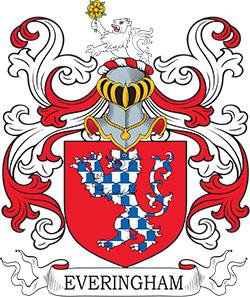
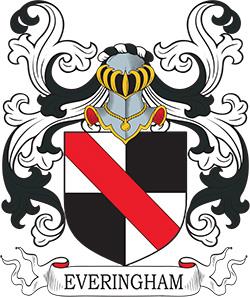
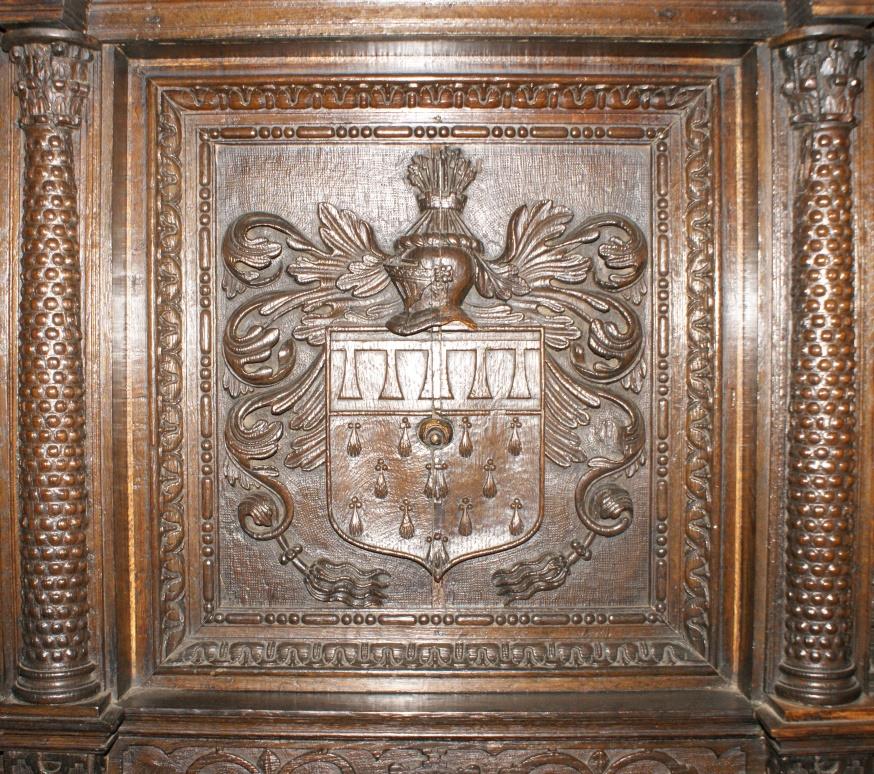
There are two coats of arms of the Everingham family. One shows ‘gules a lion rampant vaire’, although any tincture which would have shown the ‘vaire’ chequer-work on the body of the lion has long since disappeared. The other coat of arms shows quarterings of families associated with the Everinghams: that in the top left quarter is Everingham of Rockley, ‘quarterly argent & sable a baston gules’, whilst that in the top right quarter is Rockley of Rockley, as can be seen on the tomb of Roger Rockley [d.1553] in Worsbrough church. The arms in the bottom right may be Hickman of Lincolnshire, where the Everinghams had lands; the arms in the bottom left quarter have not been identified.

The strapwork cartouches with their square central panels on which each coat of arms is set are identical. The shield with the quartered arms is of a conventional shape, whereas the shield with the Everingham lion rampant is more akin to the pageant shields associated with Elizabethan tilting.
The cartouches are carved directly onto square panels of oak, which have split over time. Both panels are mounted in mitred oak frames carved with 3 different border designs. The inner border is a simple repetitive design of round beads – a distinctive feature found in carved woodwork of the NE Derbys/S Yorks region. A bead and lozenge design can be seen bordering the Bullock coat of arms on the Greenhill Hall overmantel [c.1610], whilst the beaded columns seen on that overmantel can also be found on the Rotherham church pulpit [c.1604], an overmantel dated 1623 from Norton House, and the Bishops’ House overmantel [1655].
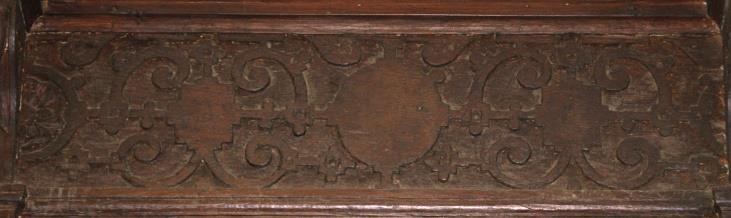
Three strapwork panels on the Greenhill Hall overmantel are closely related to two strapwork panels on the Stainborough Hall overmantel, where the central blank areas were probably enriched with carved heads originally, as at Greenhill. One of the Greenhill panels has triangles and strapwork
which could be seen carved on an overmantel or bed-head amongst the local oak furniture collected by the Rev. Reginald A Gatty, and photographed in 19079Connoiseur, 1907..

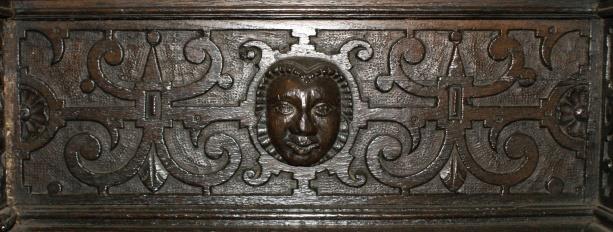


The petallated oval patera, seen on the Gatty-collection piece, is carved on two of the five terms on the Stainborough Hall overmantel. It is also carved on the inside face of these terms, in much the same way as the oval paterae which ornament the Rotherham church pulpit and the Greenhill Hall overmantel. The hare and [Talbot?] hound carved in alcoves above the strapwork are delightful.
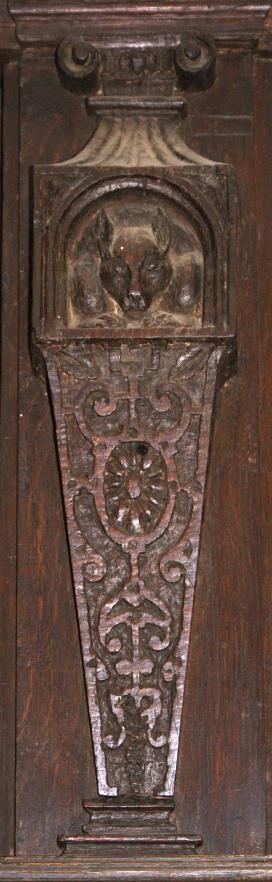


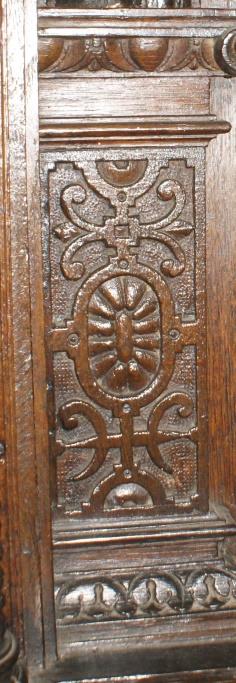
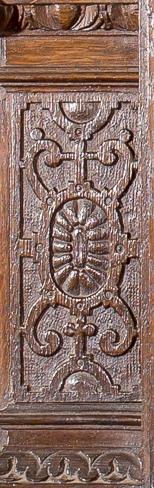
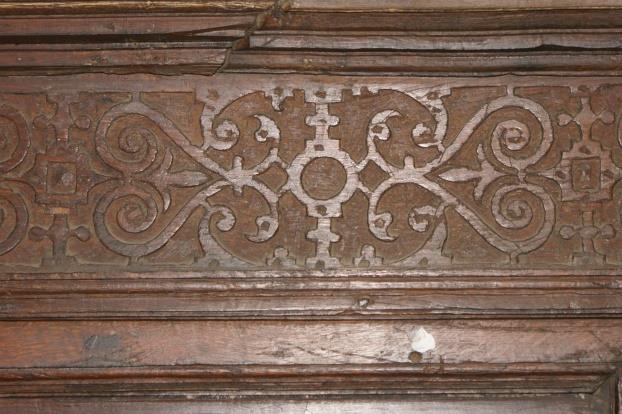
The ‘intricacy’ of the strapwork carving on the terms is of a similar quality to the carved strapwork frieze in the wainscot panelling of the entrance hall at Stainbrough Hall, suggesting this work was carried out by the same hands at the same time.
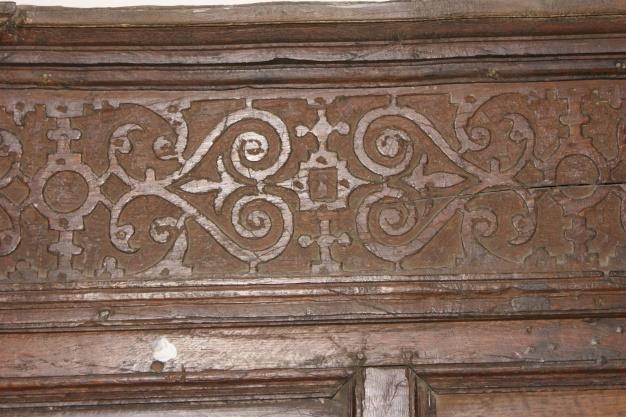
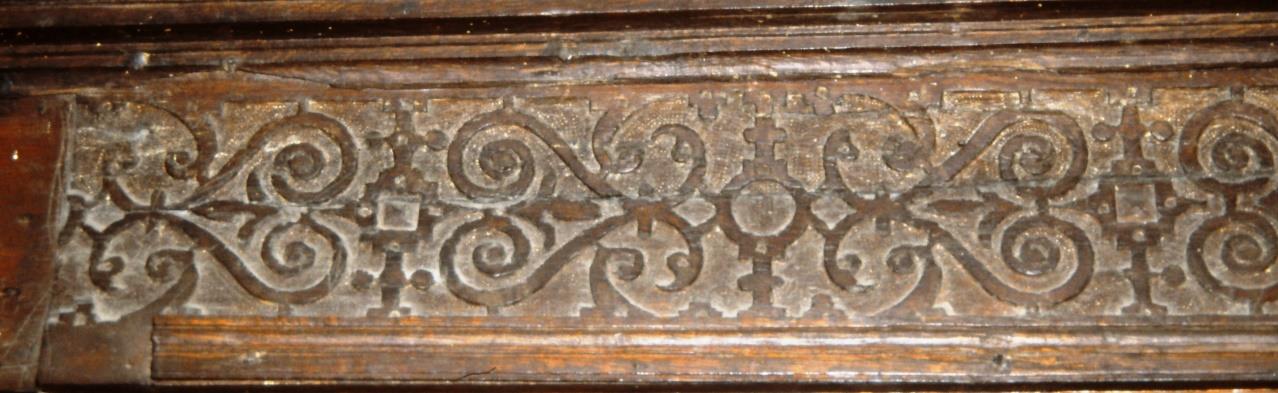
The carvings of grotesque masks which adorn the ends of the cornice on the overmantel are elements which can also be attributed to the Everingham ownership of Stainborough Hall. They are high-quality carvings, adapted from 16th century Mannerist engravings by Cornelis Floris [c.1555].

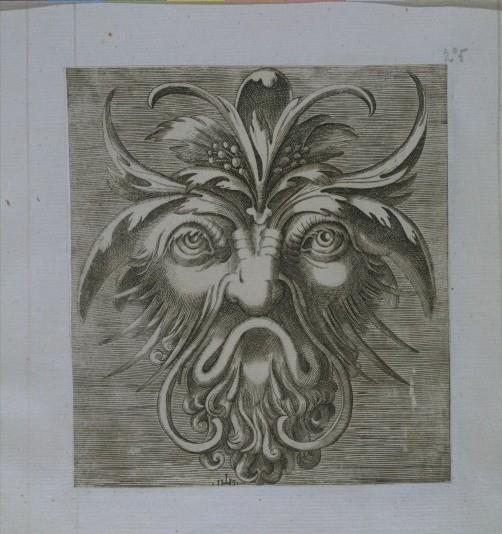
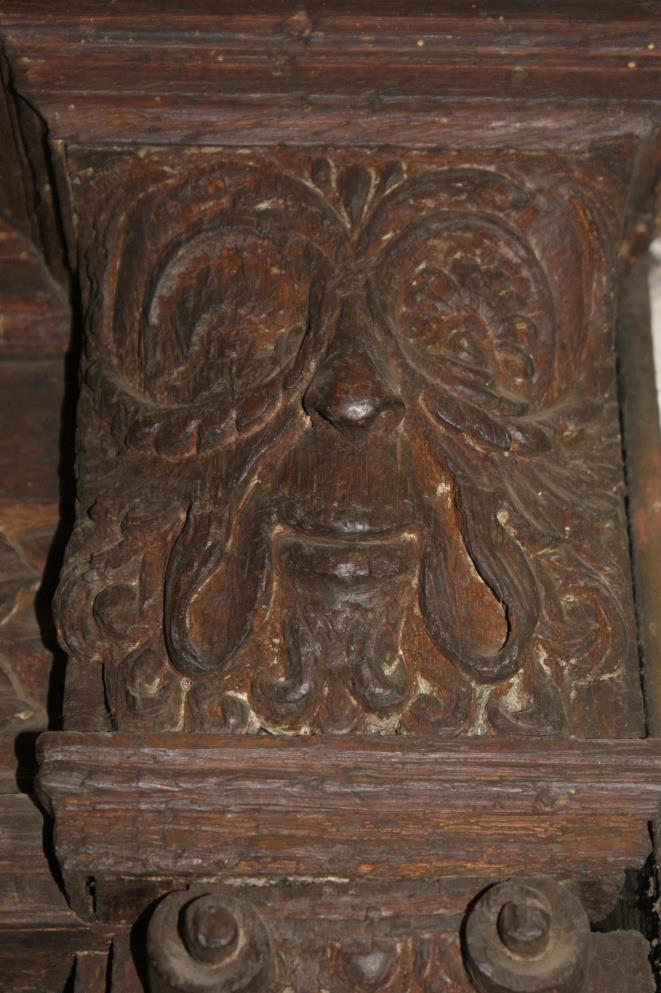
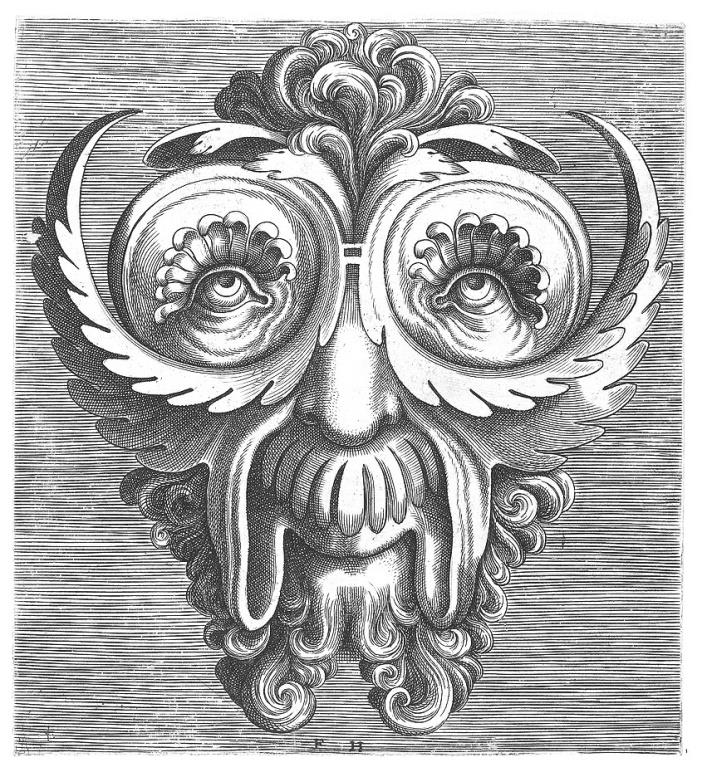
This suite of engravings of masks was known to embroiderers working for Bess of Hardwick in the 1570s at Sheffield Manor, and to decorative plasterers working in NE Derbyshire & South Yorkshire in the early years of the 17th century. One particular mask is embroidered as a keystone on the applique hanging of Lucretia [c.1573] now at Hardwick Hall, and also cast in plaster at several locations, including the oak parlour ceiling formerly at Greenhill Hall [c.1610] and now re-fixed at Cartledge

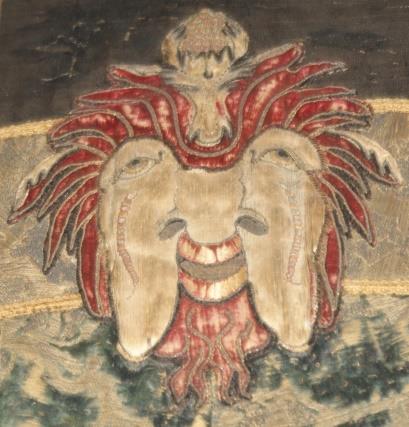
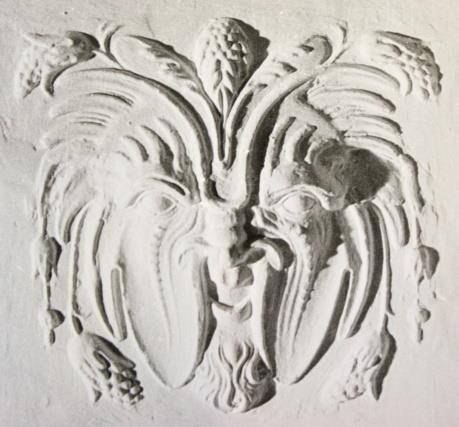
Hall, Holmesfield. There can be little doubt that the oak carvings of grotesque masks on the Stainborough Hall overmantel belong to this late 16th /early 17th century time of vigorous artistic and architectural activity in the local area.
CUTLER of Stainborough
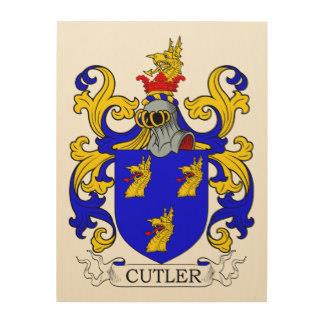
Arms: Azure three dragons’ heads erased with a bordure or. Crest: A dragon’s head erased or ducally gorged argent
Thomas Cutler, who purchased Stainborough Hall from Francis Everingham in 1610, was the son of John Cutler [c.1542-1588].
John Cutler matriculated from Clare College, Cambridge at Michaelmas, 1560. He became a Sergeant-at-Law and, when granted arms by Robert Cook, Clarenceaux herald, on 26 April 1585, he was described as “of London, late of Falthwaite, Yorkshire”10Foster, Grantees of arms, 69, quoting Harl MS 1359 fol.120b. Visitation of Yorkshire 1612..
He married Alice Copley of Birley, c.1564, and they lived at Falthwaite Grange, situated between Silkstone Common and Hood Green, and close to Stainborough. Their first son and heir, Thomas Cutler, was baptised at Silkstone church 12 March 1565, and a daughter, Gertude, on 31 August 1567. A second son, John Cutler, is named in his father’s will. As a successful barrister working in London, John Cutler was able to accumulate considerable wealth which he used to purchase property at Cubley Hall, Penistone and Pule Hill, Thurgoland. Other assets which he acquired near to his home in Yorkshire were the tithes of Dodworth and Stainborough. His wife, Alice, died in 1586 and was buried at Silkstone on 10 January that year. However, he re-married on 6 April 1587 Anne, daughter of John Wordsworth of Brook-house in Penistone, and widow of John Cudworth of Eastfield. They had one daughter, Penelope, before John Cutler’s death and burial on 9 April 1588 at Silkstone.
Thomas Cutler [1565-1623] was 23 years old when his father died. He inherited all the properties which his father had accumulated, and was thus able to contract an advantagous marriage to a local
lady, Ellen Rayney. She was the daughter of Roger Rayney of Smethley in Worsbrough Dale and sister to John Rayney, a merchant draper and Alderman of London11John Rayney of West Malling, bought Wrotham Place. He was a great benefactor, and by his will dated 25 February 1631/2 he provided funds towards the grammar school in Worsbrough, and left money to the poor of Darfield, Wombwell, Worsbrough and Worsbrough Dale.. They married in 1588: their first son, Richard Cutler was baptised at Silkstone on 3 January 1589, but was buried three months later on 25 April 1589. Thereafter, 4 more sons and 5 daughters were born, with their baptisms and burials recorded, mostly, in the register at Silkstone church: Keresford [bap.24 Aug. 1591 & bur.1 Feb 1601]; Gervase [bap.20 Apr 1593, Barnsley]; Martha [bap.1 July 1594]; Elizabeth [bap.24 Oct. 1596]; John [bur. 10 May 1597]; Dorothy [bap.1 May 1599]; Thomas [bur. 5 May 1602]; Ellen [bap.19 Jan. 1603/4]; Margaret [bap.1 Nov. 1605].
Thomas Cutler may have followed his father into the legal profession. He was noted as a J.P. in 1617, but before then appears in the accounts of William Cavendish on three occasions between October 1604 and December 1606, seemingly in some kind of financial and/or legal role: October 1604: “Mr Cutler’s charges lying at Heath 4s.” August 1605 : “Spent by Parker, Reynolds, Fretwell, Hallam & Hall carrying £1000 to Rotherham, being forth two days with seven horses and Mr Cutler & Perkin’s charges meeting them 16s 10d.” December 1606: “5 [Dec] To Mr Cutler £60 which Travice received of him to my Lord’s use at London.” Then in March 1607 the accounts record “To one that brought letters to my Lady from Mr Cutler about deer stealers”. ‘My Lady’ is Elizabeth, wife of William Cavendish, but whose late husband’s estate at Wortley – with its Wharncliffe Chase - lay alongside the Cutler lands at Falthwaite. Thomas Cutler was evidently alerting Lady Cavendish to the poaching on her estate and to the necessary action required. So, it appears that Thomas Cutler was well-known to both William Cavendish and his wife. In turn, the Cavendishes were acquainted with Sir John Bentley of Breadsall Priory in Derbyshire, whose daughter, Elizabeth Bentley, married Gervase Cutler I, eldest son of Thomas Cutler some years later. Having purchased the Stainborough Hall estate from Francis Everingham in 1610, Thomas Cutler lived there until his death in 1623. He was buried at Silkstone church on 21 January that year: his widow, Ellen, was buried there on 16 February 1635/6.
Gervase Cutler I [1593-1645] succeeded his father at Stainborough. He studied and practiced law at the Inner Temple, where he would have met John Bullock of Darley & Norton, whose family employed woodcarvers and decorative plasterers to enrich the interiors of their houses at Greenhill in Norton and Brampton near Chesterfield c.1610. Gervase Cutler I and his wife Elizabeth Bentley, whose marriage contract was dated 20 May 1620, had a son, Gervase, who died young, and a daughter, Mary. Elizabeth died in 1624 and was buried at Silkstone on 22 January. Later that year, on 18 August, Gervase Cutler I was knighted by King James I, and by 1627 had been appointed Treasurer for lame soldiers in the West Riding of Yorkshire. In 1633 he re-married to Lady Magdalen Egerton, sister to John Egerton 2nd earl of Bridgewater who was married to Elizabeth Cavendish, daughter of William Cavendish, Earl of Newcastle. Their son and heir, Gervase Cutler II, was born on 29 April 1641. During the Civil War Gervase Cutler I held the rank of Lieutenant colonel of a Regiment of Foot, but died in 1645 in the siege of Pontefract castle. In his will, dated 23 March 1638, he desired that his
body should be buried at Silkstone – a request respected when his body was moved from Pontefract to Silkstone in 1648.
Lady Magdalen Cutler [nee Egerton] died on 24 September 1664 and was buried at Silkstone on 25 October that year. Her son Gervase Cutler II who had been but 4 years old when his father died, inherited the Stainborough estate at the age of 21 in 1662, and married Dorothy, daughter of Henry Frankland of Aldwark, North Yorkshire on 16 November 1665 at Alne. No doubt assisted with money from the marriage settlement Gervase Cutler II was able to build the ‘Cutler House’ in the years 1670-72, thus grafting a substantial block of fashionable accomodation onto the old Stainborough Hall. Sir Gervase Cutler II died in 1705 and was buried at Silkstone church on 6 July: his wife, Dorothy had pre-deceased him and been buried there on 21 December 1695. His son, Henry Cutler sold the estate in 1708 to Thomas Wentworth, Lord Raby.
The woodwork in the Cutler House continued:
Although John Cutler was awarded arms and a crest in 1585, these arms do not appear on their own in the entrance hall overmantel of the Cutler House. The Cutler family of Falthwaite & Stainborough originated from Eye in Suffolk, and it is the quartering of the arms of Cutler of Eye which is carved in the overmantel, alongside another coat of arms showing Cutler impaling Frankland for the marriage of Gervase Cutler II to Dorothy Frankland in 1665. Both coats of arms have been re-set on oak boards at some later date, with religious inscriptions in Latin inlaid as mottos: “…..Christos” and “Deo tibi”. The Cutler of Eye arms are carved on a shield of an appropriate shape for the early 17th century, and the strapwork cartouche in which the shield is set is also convincingly correct for that time, and corresponds closely to the Everingham cartouches alongside. However, the shape of the shield bearing the arms of Cutler and Frankland shows considerable signs of alteration – possibly to make the arms appear visually ‘en suite’ with the other three coats of arms set amongst the carvings which make up the overmantel.

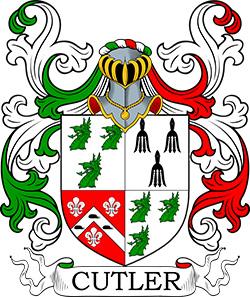

The panels on which the coats of arms are mounted are held in place by mitred frames carved with a design of overlapping leaves with beaded edges centred on a four-petalled flower. These carved frames are visible on three sides only as the fourth side is lost behind the cornice of the lower tier of the overmantel – a further indication of the later re-assembly of the carvings. Whilst the arms of Cutler impaling Frankland also features the dragon crest of Cutler set on a helm with attendant mantling, the arms of Cutler of Eye have no dragon crest but, instead, a bearded male mask with leaves forming part of the strapwork cartouche. Similar faces peek from rectangular panels atop the three strapwork pedestals, of identical design, which border the coats of arms, suggesting that all these carvings were done in the same workshop at the same time.

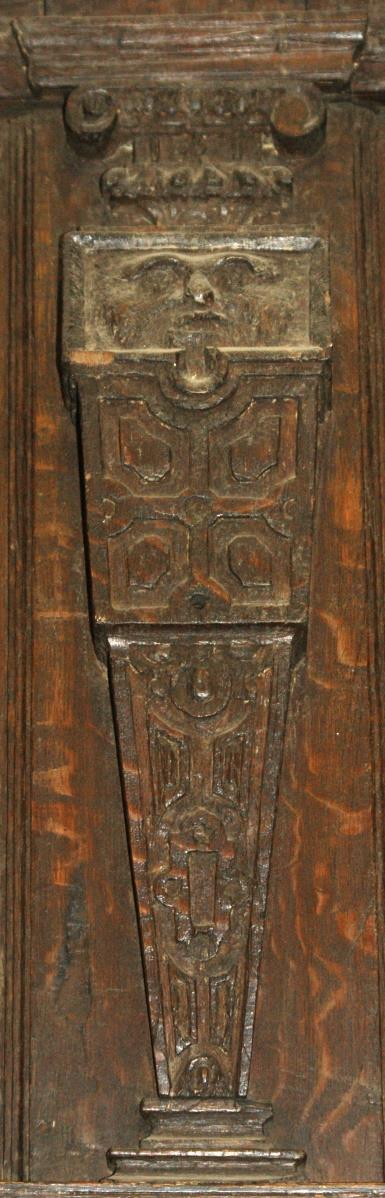

Today, only one of these pedestals still has its plinth, but all three have their capitals terminated by scrolling volutes.
The lower tier of the overmantel is formed of 5 panels set beneath arches enriched with a border of dog-tooth ornament, and with foliate triangles set in the spandrels.

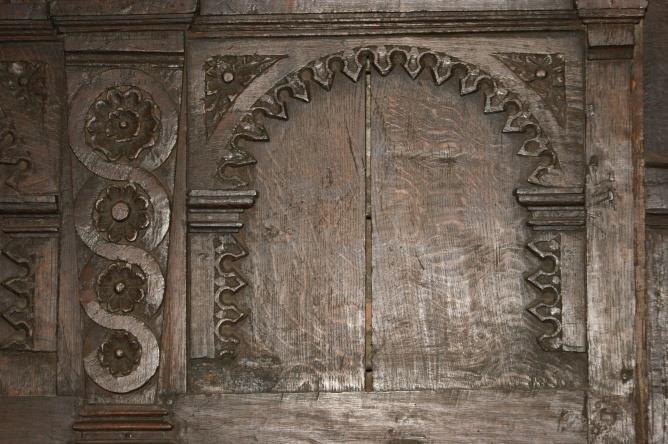


Three of these arcaded panels have fragments of carving applied to them: leaves, fruits and curly tendrils – all consistent with carved and cast details found elsewhere in the Sheffield region in the early – mid 17th century. The dog-toothed pilasters supporting the arches have moulded capitals, but their bases are missing, although the shadow line of where they were attached is evident. One of these bases survives, now detached from the rest, and is recognizable as an inverted capital with curly volute – evidently re-fashioned to this position when the overmantel was assembled. The 4 tapering pedestals set between the arcaded panels are carved with a guilloche pattern containing, at top, 5-petal double roses with 3 X 8-petal flowers of diminishing size below.
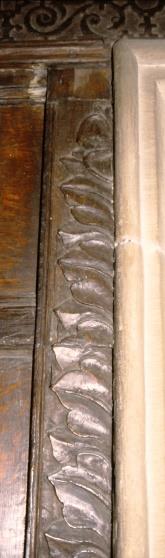
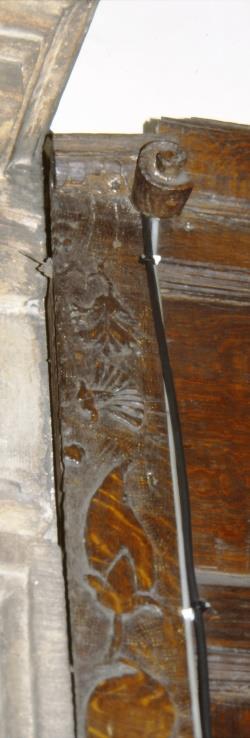
That the overmantel – with the exception of the arms of Cutler impaling Frankland - was created from carved woodwork of the late 16th and early 17th centuries there can be no doubt. Some of the carved work, dating from the time of Francis Everingham, bears a strong relationship to that in the Greenhill Hall chimneypiece, now in the care of Sheffield Museums at Bishops’ House. One distinctive feature of the Greenhill Hall oak parlour panelling are pilasters carved as long stems with close-set leaves bearing flower-heads set below capitals with curly volutes. Remarkably, portions of such leafy pilasters – and curly volutes - survive in the entrance hall of the Cutler House, re-fitted around the 1670s stone doorcases. These leafy pilasters could be seen not just at Greenhill Hall [c.1610], but at Carbrook Hall [1623], Ecclesfield Priory, Norton House [1623], Renishaw Hall [1625], Bramley Grange [1637] with a final appearance at Bishops’ House [1655] flanking the parlour fireplace. There can be no doubt that much of the carved woodwork, and associated panelling, in the Cutler House at Wentworth Castle, belongs to this group.